Aspen’s Signature Pedestrian Mall Turns 50
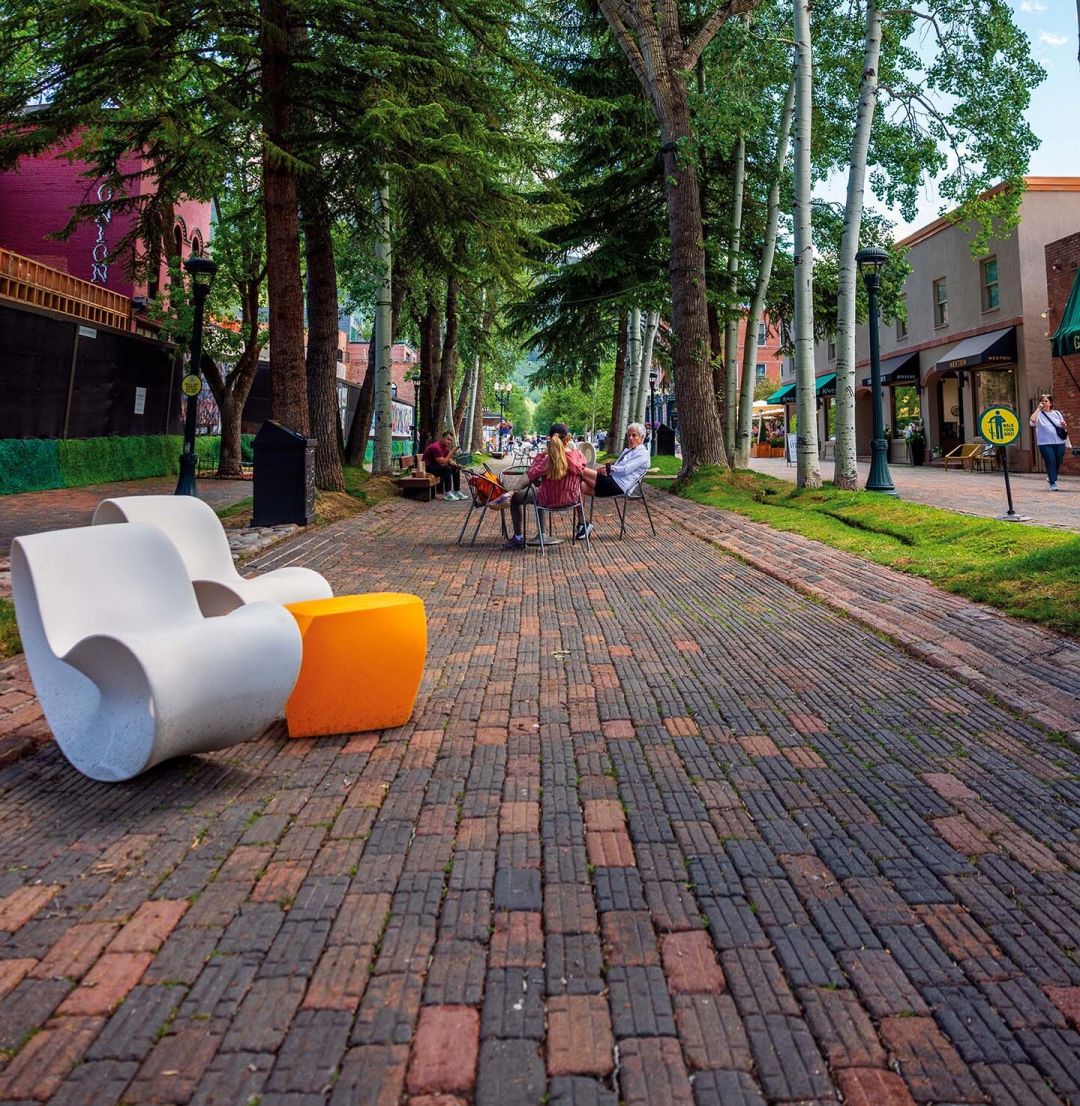
Image: jake wheeler
In 1972, two local teenagers championed an urban planning ideal that would forever transform the look and feel of downtown Aspen. Plans for a pedestrian mall had been in circulation since the mid-1950s, and the concept had been tested via temporary demonstration projects in 1961 and 1966, but the collective will to forever ban cars from a portion of the city’s downtown core remained elusive until Margot Dick and Katie Dutcher decided to rally their city around the cause.
Both 18-year-olds had been active in the community and were steeped in its liberal-leaning politics. At Aspen High School, where most of their teachers were young and sympathetic to local radicals who called themselves “freaks,” a classmate, Chapin Wright, had convinced students to march through downtown Aspen on Earth Day and briefly close off streets to automobile traffic. After Wright tragically died on the day of their graduation that year, Dick and Dutcher decided to memorialize their friend by spearheading a public campaign for a permanent pedestrian mall.
“Back in that summer of 1972, [Katie] and I decided something should be done about the congestion, the dust, the auto fumes, and noise in downtown Aspen,” Dick recalled in a 1976 Aspen Daily News retrospective about the mall. “The inspiration for us to really do something about a permanent mall came after Chapin’s death.”
It helped that the young women, close friends since elementary school, had ties to local and regional government.
Margot Dick was the daughter of Nancy Dick, an influential attorney who would serve two terms representing the 57th District in the Colorado House of Representatives in the latter half of the 1970s, followed by another two terms in the ’80s as the state’s lieutenant governor. Inspired by her mother, Margot became Aspen High’s student representative on the Aspen City Council (a position that only existed for a short period of time). Kathy “Katie” Dutcher worked for then Aspen Mayor Eve Homeyer in her downtown shop, House of Ireland, which imported fabric and sweaters from the Emerald Isle.

Together, they found a kindred spirit in local attorney Joe Edwards. Edwards was famous as Aspen’s “hippie lawyer” after winning a landmark 1969 civil rights trial, advocating for equal treatment of the city’s long-haired residents and rabble rousers. He was also the protagonist of Hunter S. Thompson’s 1970 Rolling Stone cover story “The Battle of Aspen,” which chronicled Edwards’ unsuccessful 1969 bid to become Aspen’s mayor (losing to Homeyer by six votes). Later, as a Pitkin County commissioner, he became instrumental in helping steer the Aspen area’s development around preservation and other local priorities, and ultimately was inducted into the Aspen Hall of Fame in 2013. When the two young women knocked on his door, Edwards respectfully listened and accepted the pro bono commission, becoming their ally and the legal muscle behind a movement to create a permanent downtown mall.
Edwards suggested pursuing a process in Aspen’s 1971 charter known as an initiative petition. If signed by 15 percent of the city’s registered voters, their petition could then be brought before Aspen’s city council, which could either vote to adopt it by ordinance or call a special election and have the public decide. So, collecting signatures outside Aspen’s downtown post office. Aspenites were very receptive, and they gathered far more signatures than they needed. Before leaving for college (Dick bound for Ohio’s Oberlin College, where she would major in city planning, and Dutcher for Wisconsin’s Beloit College to study law), they submitted their petition to create a permanent downtown pedestrian mall, which the city council adopted by ordinance, appointing 10 citizens to a Mall Commission to guide the project to fruition during the extended absence of its young champions.
“We were doing the right thing at the right time and had the right support,” recalls Dick, now 72 and living in Seattle. “That whole period of Aspen history, which turned out to be incredibly important in preserving land in the Roaring Fork Valley, along with the work we did, planted the reality that the downtown would have this protected, beloved place.”

Proof of concept
In 1956, architectural design students from the University of Utah convened at the Hotel Jerome to brainstorm ideas that would shape Aspen’s future cityscape. Inspired by the previous year’s International Design Conference in Aspen and in particular architect Victor Gruen—an urban revitalization specialist who designed the country’s first outdoor pedestrian mall in Kalamazoo, Michigan (completed in 1959 )—they advocated for a similar plan for Aspen.
Five years later, after attending an urban planning seminar hosted by the Aspen Institute, panelist and architect Richard Lai appeared before Aspen’s city council seeking permission to test the concept of a downtown pedestrian mall. Lai, who had written his master’s thesis proposing a pedestrian mall for Aspen, argued that just as tourists made pilgrimages to places like Venice and Spain’s Santiago de Compostela to stroll car-free plazas, visitors who traveled to Pitkin County to experience signature summer experiences like the Aspen Music Festival deserved a central public place where they could gather and enjoy the mountain town’s outdoor amenities, free of the nuisance of automobile traffic.
With the city’s blessing, over 10 days that August, Lai and a group of community volunteers segregated one block of downtown Aspen (Cooper between Galena and Mill) with boxes made from railroad ties that were filled with colored gravel. Within the perimeter, they anchored fir trees to the ground with rebar, installed sculptures donated by the Aspen Design Festival, built a stage for jazz and chamber musicians, and opened a water main to create a stream running through the middle of the urban oasis. It was magical, and local newspapers declared the experiment a success.
“That helped start the impetus for the permanent replacement,” Lai recalls.
Although the concept had been tested and embraced by most Aspenites, the goal of a permanent mall remained elusive, mired in the red tape of committees, paperwork, and public debate for more than a decade. Meanwhile, Aspen paved its dirt streets in 1963, which at least helped control the swirling dust that generated complaints from tourists and locals about walking around town. A second temporary mall was reprised in July 1966, during which Cooper Avenue became a venue for outdoor dining and a robust entertainment program.
Discussion and planning continued in earnest after Governor John A. Love signed the 1970 Public Mall Act, which gave Colorado cities legal authority to close off public streets to create pedestrian malls.
It was into this milieu that Dick, Dutcher, and Edwards entered, formalizing the community’s support with their petition during the summer of 1972. Pressured by these advocates to finally act, Aspen’s city council voted to forgo a special election and instead use the extra time and funding to host a temporary mall during the summer of 1973 (reprised during the summers of 1974 and 1975 ) as a precursor for a permanent mall. In addition to creating the Mall Commission, local and regional land-use and transit regulations were amended to permit it, and perhaps most importantly, a 1 percent, voter-approved tax was created to build and maintain it in perpetuity.
Of course, a permanent pedestrian mall wasn’t unanimously popular—a grassroots movement dubbed Coalition for Concerned Citizens objected, arguing that a loss of parking spaces would deter customers from patronizing downtown shops and restaurants. But for the most part, Aspen residents and business owners embraced it. The Aspen Times, a full-throated supporter since the ’50s, published an editorial in August 1973 calling that summer’s temporary mall “the best thing that has happened to Aspen since the invention of the internal combustion engine.”
As for Dick and Dutcher, “We both went away to college, leaving the city to hold the bag,” laughs Dutcher, who, after earning a law degree, followed the example of her lifelong Aspen friend and settled in Seattle. “But Joe [Edwards] reminded us that it became a community project—it took on a life of its own.”
It became a movement to preserve a signature laid-back mountain town vibe that many, even 50 years ago, felt was in jeopardy of being lost.
“A lot of people in Aspen shared this sense of wanting a place downtown where you could sit on a bench with the sun shining and people playing, where there was a sense of delight and calmness at the same time,” says Dick. “We had that growing up in Aspen and could see it disappearing. We wanted to capture this magic that we had in a bottle.”
“And the mall was the bottle,” adds Dutcher. “We were looking for a way to preserve that magic.”

Realizing the dream
Carving a C-shape swath from four city streets in the heart of downtown, Aspen’s pedestrian mall, which was constructed over the summer of 1976 for $1.5 million ($8.7 million today), was the first in Colorado to convert roads from vehicular traffic to pedestrian use. It was part of a wave of similar projects across US cities that sought to reduce conflicts between people and cars—as vehicular traffic increased dramatically in the postwar era—while preserving thriving, walkable downtowns. Boulder’s Pearl Street Mall, under construction at the same time, was dedicated shortly after Aspen’s in 1977, and Denver’s 16th Street Mall followed in 1982.
Three architects were consulted to design Aspen’s permanent mall, all of whom had worked for or studied under Frank Lloyd Wright. Fritz Benedict, Aspen’s foremost architect of the time, whose imprint was all over town, had participated heavily in the design and planning of the temporary malls. Curtis Besinger, a longtime University of Kansas architecture professor, maintained a practice in Aspen with Benedict, most notably working together on the Aspen Music School campus on Castle Creek. Overseeing the mall project was Robin Molny, who had worked for Benedict when he first moved to Aspen in the mid-1950s. Molny, whose work in Aspen includes the historically designated Hearthstone House and Aspen Athletic Club building (the latter currently undergoing a remodel), was also an early mall proponent who made the case that it could unify downtown.
Influenced by Wrightian concepts and the local mountain landscape, Molny and his team designed the mall as a bridge between the urban and natural environments. They “created a place of beauty, respite, and community gathering in an urban environment below snowcapped peaks,” opined an architectural inventory that was later submitted with an application for historic designation for the mall. “It combined hardscape formed through the installation of brick paving, along with a softscape of grass, trees, and moving water.”
The two longer streets of the mall, Hyman and Cooper, were divided into segments by two strips of landscaping, planted with crab apple trees and turf, that in turn had narrow watercourses running through them. The design encouraged peaceful wandering. Benches and other seating areas were placed throughout, and antique pole lights were used to create a soft glow at night. Plazas at the mall ends were uniquely designed with features encouraging lingering. These include a playground near Wagner Park, Independence Square at the east end of the Cooper Mall, and a rectangular fountain at Hyman and Galena.

Citizens were, once again, involved. The city offered a program for people to donate trees and benches, with the names of donors burned into the seat backs.
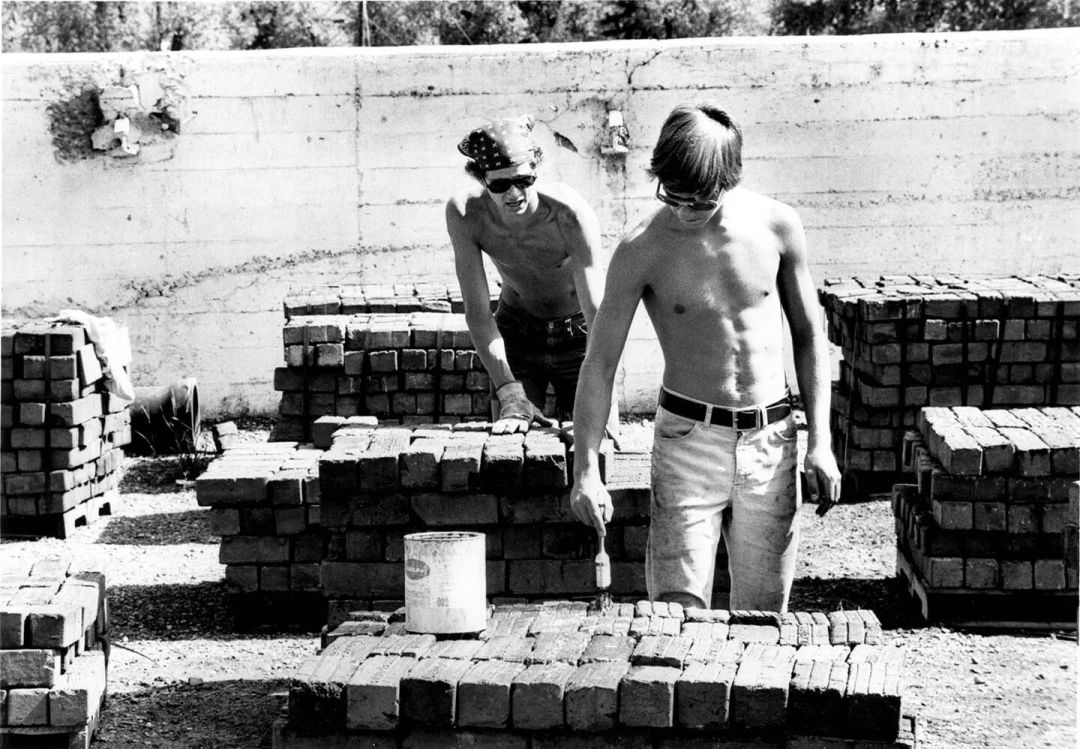
A total of 310,000 bricks were used to pave the mall, purchased from the City of St. Louis, which was replacing its cobblestone streets with pavement. Fired between 1890 and 1900, each of the 4x4x9-inch bricks weighed 10 pounds, arriving that summer by train in 26 railroad cars. Different styles of bricks (some of them stamped “Egyptian” or “Culver Block”) were laid in different patterns, colors, and heights, with those lining the landscaping rising at a gentle incline from the main walkways.
At 1 p.m. on October 2, 1976, the city gathered in Independence Square at the intersection of Cooper and Galena Streets to witness Mayor Stacy Standley place the last brick with a trowel that was specially engraved for the occasion (“The Aspen Mall Dedication, Oct. 2 1976: 310,000 bricks, four streets”), which he then handed over to a custodian from the Aspen Historical Society to be logged and preserved as an artifact in the evolution of Aspen.
Overnight, then over years and decades, the mall wove itself into the fabric of city life.

The public art that has come to define Aspen’s pedestrian mall may not have happened without a nudge from the citizenry. As the bricks were being laid, sculptor Bill Jamison and architect Tony Coleman, who worked for Molny, came forward to request funding for public art—none had been set aside previously. Jamison launched a mall sculpture contest to choose its first artworks, including a two-piece geometric metal sculpture by local Missie Thorne titled Aspiring Squares. More art was added over the years, including a sculpture, Interplay by Ki Davis, installed within the rectangular fountain at Hyman and Galena in 1979. Later that year in the square across from Wheeler Opera House, local sculptor Travis Fulton and electronics wizard Nick DeWolf debuted their Dancing Fountain, a functional artwork with water jets that erupted from the ground in a computer-controlled randomized pattern, that has become Aspen’s iconic summertime playground for children (and adults). A private citizen placed a large metallic bear, standing on its hind legs, outside an art gallery on the Hyman Mall in 2005—the city acquired it a few years later and made it permanent.

The mall also has inspired performance art, in its early years serving as a stage for the Aspen State Teachers College, a troupe of locals who created the make-believe university, complete with “classes” in fun and farcical subjects, and indulged in pranks, skits, and eclectic public activities, such as “mall bowling,” where the bowler rolls a beer keg toward a group of human “pins.”
“The mall is the birthplace of the city’s public art program,” notes Lara Whitley, who currently leads Aspen Public Art. “The mall and the public art within it are important because everyone deserves access to a creative life. As Aspen gets increasingly expensive, our pedestrian mall is a place filled with beauty, both nature-based and man-made, where all Aspen residents and visitors can gather for free.”
“Good design matters to people,” says Dutcher, whose early experience in Aspen inspired her to become an architect and practice in that profession for 45 years. “The power of good urban design is illustrated in the Aspen mall. It is scale appropriate, restrained, and welcomes everyone.”
Work in progress
In 2016, the City of Aspen launched a mall improvement project. Envisioned as an extensive, multiyear endeavor with plenty of public input, it sought to replace aging infrastructure (mostly utilities below ground) and deteriorating bricks (most of which are over 125 years old), and address safety issues and the health of an urban forest planted in 1972.
But around four years into rehabbing Aspen’s landmark of urban planning (in 2018, the American Planning Association named the mall one of the “Great Places in America”), the city shifted its attention to other large-scale and more urgent infrastructure projects, such as the Lumberyard workforce housing development and the entrance to Aspen, and parked the idea of overhauling its mall. In the short term, the city parks department is in charge of its maintenance, and the only definitive project in the works is safety related: permanent bollards at the curve across from the Wheeler where the closed portions of Hyman and Mill Streets converge with auto traffic.
“The ultimate plan is it’ll look like how it is now,” says Mike Tunte, a landscape architect and construction manager for the City of Aspen Parks and Open Space Department, underscoring that the mall of the future will be very recognizable to its pioneers. That may be a comfort to longtime locals overwhelmed by the many cityscape upgrades underway.
“Cities are like clouds; they’re constantly changing,” he adds. “Some say Aspen is in jeopardy of losing its sense of community. But the one constant in Aspen is not just the pedestrian malls but our public spaces in general. It’s as important as ever today that we look out for those spaces, those amenities that continue to accommodate our community.”
In fact, Aspen is one of the few American cities to have retained its pedestrian mall, with most others giving them back to cars. The American Planning Association (APA) touts Aspen’s mall as a lesson in realizing urban planning excellence.
“The 20-year process that led to the development of the Aspen Pedestrian Mall is representative of the challenge that many planning projects face,” the APA notes. “The idea of prioritizing people over automobiles remains an important value in Aspen, and the mall is a safe, family-friendly, and inviting place to walk and socialize.... The city and community have shown commitment and dedication to the mall, particularly in recent years, including a 2017 designation as a historic landmark by the city council.... Today it serves as one of the most beloved places in Aspen. It is a pedestrian refuge, a social gathering place, a Colorado cultural icon, and much more.”
Call it one of Aspen’s last remaining third spaces.
“The mall is the crossroads of Aspen where everyone is welcome,” says Lara Whitley. “And you can feel it.”
This still matters very much to Margot Dick and Katie Dutcher. Both (along with everyone interviewed for this story) speak of the wonder of sitting on a bench on the Aspen mall and looking up at Ajax.
“Aspen’s attractiveness is for people who don’t have a place to look up to a mountain,” says Dutcher. “The mall gives people time to experience that nature that they might not have any connection to when they’re not in Aspen, wherever they live.”
For locals, “when you are grounded in the place you live, a lot of good things happen,” adds Dick. “There’s a lot of destruction in the world, but people who love a place contribute to it, build it up, cherish it. That’s why it’s important to have beloved places. The mall is the interface between the town and the trees and the mountain, and we have to have these connections if we want to preserve the earth.”

Golden Opportunity
This summer, the City of Aspen and its public art program are hosting a multi-month block party: Mall Fest 50, a series of public art experiences celebrating the Aspen pedestrian mall’s golden jubilee.
Through October, mall visitors can wander beneath an installation created by textile artist Rachel B. Hayes, Shifting Light, 10 large, vibrant, hand-sewn panels installed in the tree canopies over Hyman and Cooper Streets.
An art parade on the morning of June 27 invites revelers to don a costume, maneuver a people-powered contraption, or stage a performance along the route traversing the malls and Aspen Saturday Market. The theme of the event is “What do you love about this place?” and participating businesses will offer $19.76 specials all day long.
For more info on Mall Fest 50 and to register for the free parade and community workshops preceding the main event, visit aspenpublicart.com.