Bootpacking: An Aspen Tradition for More Than Two Decades
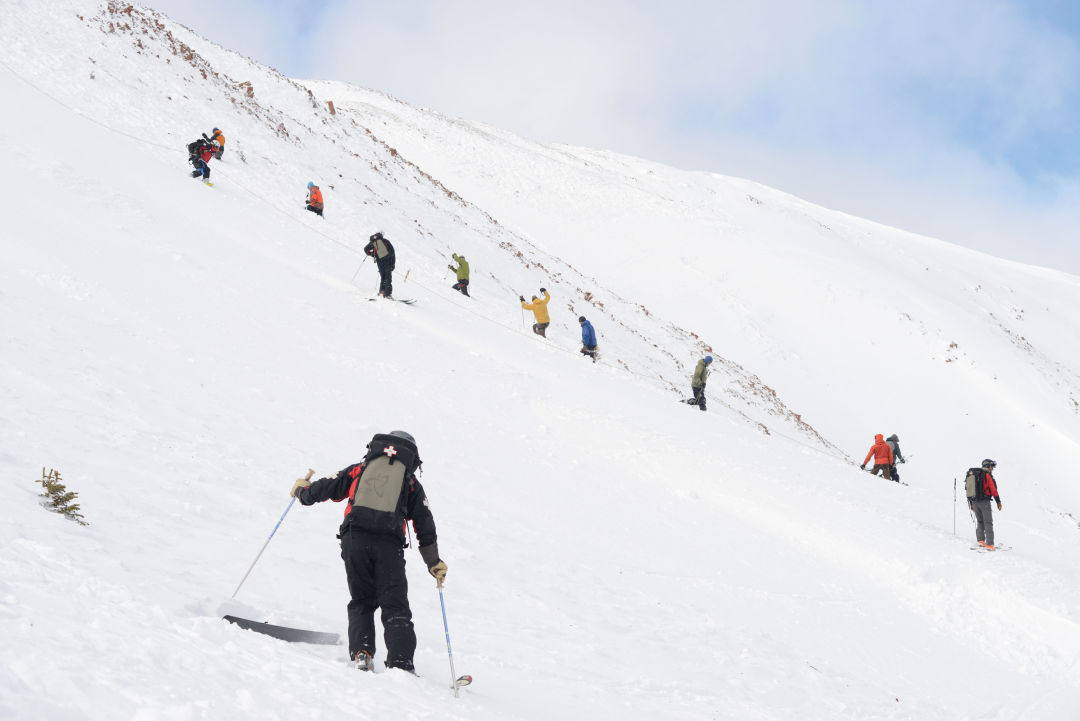
For expert skiers and snowboarders, dropping into the Highland Bowl from a 12,381-foot summit at Aspen Highlands strums the heartstrings like a love affair. Getting there, which requires riding a couple of 30-year-old chairlifts and hiking 45 minutes up a wind-whipped ridgeline (ascending 782 vertical feet), is more like flirting with a heart attack. And opening this terrain to the public? That’s another story altogether.
From early November to mid-December (sometimes earlier, sometimes later), a hard-core crew of paid ski patrollers leads a horde of local ski bums in a march up and down and across steep (as much as 48 degrees) slopes in the bowl, stomping down fragile, early-season powder to build a base and mitigate avalanche danger later in the season. The process is known as bootpacking. Just north of the Highland Bowl on Loge Peak, bootpackers also help patrollers tame gladed terrain under the Deep Temerity lift and the double-black slopes of Steeplechase next to that. Farther north and lower on the mountain near Cloud Nine, they scramble over rock bands and deadfall, tamping powder in the Olympic Bowl—in stiff ski and snowboard boots no less.
Each day of hard, manual labor can be cashed in for a lift ticket or a discounted ski pass (for the first time this season, bootpackers also will earn an hourly minimum wage). Make it to 15 days, and a bootpacker can claim unlimited lift access to all four Aspen Snowmass mountains for the winter ahead.
Despite the total abuse of body and equipment that bootpacking often entails, these masochists seem to be having a good time. And, I should confess, I’m one of them. Last winter, I spent eight days as a volunteer bootpacker, sweat-soaked, freezing, sunburned, and exhausted, yet smiling as I struggled my way toward a cheaper ski pass.
Misery loves company, right?
“If you’re suffering, you’re not the only one suffering,” says 33-year-old Whitney Wilson, who started bootpacking a few winters ago. “That builds a lot of mutual respect.”
The sense of community is part of the draw too: Bootpackers are “incredible” and “hilarious,” and they often “have your back,” she says.
Bootpacking the bowl has been an Aspen Highlands tradition for more than two decades, so some veterans have been schlepping around the mountain longer than Gen Z bootpackers have been alive. Much credit also goes to the patrollers who lead the program and have to consider snow science, risk management, and mountain safety while supervising a herd of civilians tromping around in high-alpine (and potentially high-consequence) terrain.
Yet there’s little feeling of hierarchy or dominance on the mountain. If they don’t already know it going in, bootpackers learn quickly that reverence, respect, and appreciation are more important than showing off.
“What I see out there is camaraderie and not judgment,” says Bob Ward, the founder of the Ute Mountaineer, who got into bootpacking a few years ago. “People are kind to each other, and it crosses all the barriers of age and gender.”
Ward, turning 75 this winter, has been in the valley for almost five decades. And he sees this program as proof that old-school “elements of Aspen are still alive and well,” despite talk to the contrary.
The folks who run the program get that, too. Sure, it’s helpful to have a bunch of extras to get things ready for the season. But there’s also value in the relationship that this program represents.
“Highlands is such an important part of our local skiing community, and it means a lot to us to be able to involve them in the preparation of this special terrain,” says Mountain Manager Kevin Hagerty. “It’s just amazing to see how many people are able to enjoy the Highland Bowl.... For so many people, this is their favorite part of skiing our mountains,” Hagerty adds. “I’m proud we’re able to make that possible for our guests and community.”